There is a terrible joke that goes with the title of this post, but there is a less humorous strategy behind the color choice. This year's color for woodenware matches the shade used for Rubbermaid garden sheds and that is no accident. It's a strategem for "hide in plain sight," one of many means a large number of us use to integrate beehives into complex, populated areas without either sowing fear or surrendering to ignorance. I do not feel that my fellow citizens need an "in your face" introduction to beekeeping, and truly believe that behaving in that manner will hurt all of us (and the honeybees). But the bees can make major contributions—and knowledgeable beekeepers can continue to learn and grow—in many locations where "out of sight, out of mind" is not an option.
This blog has languished for the same reason that urban beekeeping can land in a load of trouble if beekeepers are not careful: lack of equilibrium. Every sustainable habitat has one—a unique combination of opportunities and compromises for life that works across different co-located populations, season after season. Ever since starting as a beekeeper, I have tried to hammer home that anyone who really cares about the bees has to make sure that they are good neighbors through insightful and attentive management. I am gonna yammer on about the beauty of that a bit more. An example of what I mean: As anyone who ever had to maintain a house knows, water is both a good thing and a bad thing. Water is a basic input of life and health, and a break in service would be a major crisis in most American homes. Water is also insidious, insistent, and a relentless finder of gaps, reservoirs, and interactions with the substances all around us. Water out of place is also an emergency.
Living things are like water to the third power: your honeybees are not only pollinators and progenitors, they are constant explorers of the surrounding ecosystem, looking for forage and future home places and water sources and, sometimes, other bees of whom to take advantage. They are dynamic, intelligent in ways of which we continue to learn more each year, and dedicated to the pursuit of that ecological niche that will help their family grow and prosper. This means they may be tempted to swarm in your neighbor's yard, and then move into her/his attic. They might be prefer the water fountain at a park on your block. If they get into a robbing frenzy, the pheromone in the air can lead them to sting unsuspecting creatures. It is your absolute responsibility as a beekeeper to work against any such possibility, and to remediate any situation that develops, whether its your bees or not. In fact, one reason to have urban beekeepers is to make sure that some of them are around to address situations like this that do happen with feral colonies.
You can now buy a beehive from Williams-Sonoma (with no bees, thank goodness), and there are "services" in most major American cities that will allow you to order a hive with bees in it to be delivered. People think harder about buying birdfeeders, I think.

Ask me offline about the Planned Parenthood swarm though!
The bees' pursuit of living places and forages is their search for equilibrium, and my efforts to educate DC beekeepers and rescue as many good Apis mellifera genes as possible is mine. Some opportunities always do get away in the complicated, multi-variable natural world. But I think a lot about something called "The Nash Equilibrium," which is a theory that, in multi-player environments (meaning anything from real life) the situation is almost never "winner take all" or "you win, I lose." It means that there are usually multiple points where well-being is optimised, and our job as the cerebellum-rich species around here is to try to identify and get to those.
That means making honeybees at home near people who do not necessarily want to know about them, making green spaces flourish even when its a low priority for many members of the community, and making people who generally support beekeeping understand where the amount of time and attention they can afford to share works toward balance and peace for us all.



 The Beekeeper's Handbook, Third Edition
 The Beekeeper's Handbook, Third Edition
 First Lessons in Beekeeping
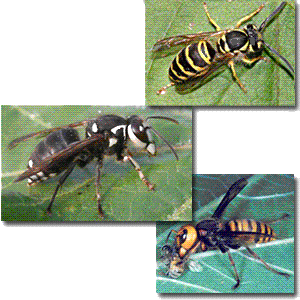 Two things happened yesterday to prompt this post: first, the DC Public Parks hive at the Lederer Youth Garden was wrongfully accused of harboring terrorists, and second, misperceptions about honeybee ferocity are causing nearby jurisdictions to get antsy about bees.
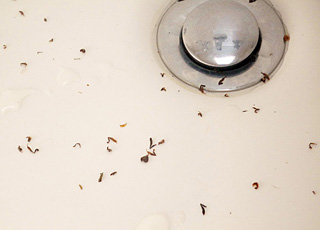 Many, indeed, are the joys of beekeeping which I've wanted to share with you. For those of you with delicate spirits, please accept my warning that this one might be kindof gross.
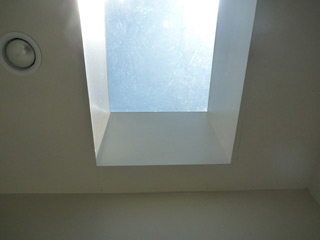 Which brings us to my bathtub. There's a skylight over the tub, and about 18 inches beyond the edge which you can see in the picture is the Wilde hive. Two feet or so to the left is the Twain hive. In season, about 4,000 bees a day die up there (have cheer: this year they are reproducing at least as fast).
 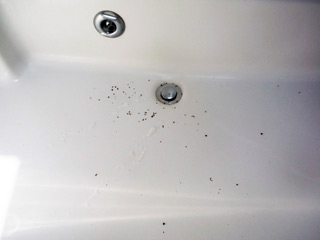 This is a fairly normal afternoon view of the tub. The close up above illustrates a number of things learned from this summer. The first is that bee heads and legs are apparently not good eating. The second is that the heads float pretty well.
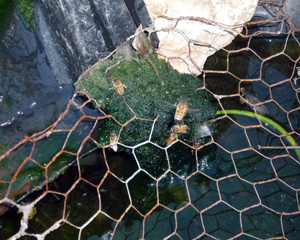 This has been the Spring of Urban Beekeeping Promotion, and it seems to me that this photo might be the single most helpful thing I could show or tell to city beekeepers. Bees need to bring water back to their hives, especially during warm weather, and bees who wander into neighbors' yards to do so can inadvertently become the authors of their own demise. In Howard County, not far from here, a major zoning smack down started because a permanently (unsway-ably! steadfastly!) terrified man noticed bees were grabbing water from the air conditioner offtake in his back yard. No stinging required, just a few thirsty bees.
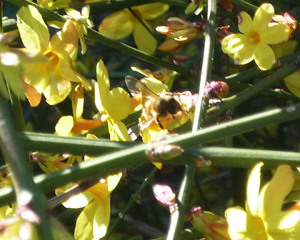 On other fronts, I would like to say that I still look after 9 survivor hives, but I don't call this season a success until April 1, when just about any decent laying queen and a few thousand workers can make it around here. The bees are flying from all the hives, some seem to be prioritizing nectar, and some are all about pollen. This, of course, worries me, since worrying is what I can do between the limited feedings some of them seem to need.
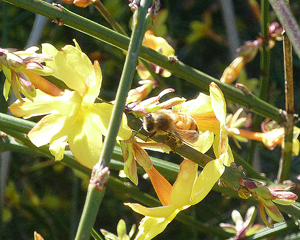 At first, I thought they might be foraging propolis from the buds, or that they might just be desperately trying to find any food at all, but on close inspection, I can see those little red tongues finding nectar after all.